
About Me
Hi, I'm James. 👋
I'm an assistant teaching professor at the University of Washington Paul G. Allen School of Computer Science & Engineering. I teach courses on programming, artificial intelligence, and social impacts of computing. As an educator, my goals are to help students discover and sustain a love for computing, and to promote a vision for computer science as a human-focused, empathetic, and self-critical discipline. My scholarship focuses on the intersections of computing education, AI, ethics, and public policy.
This autumn, I'm teaching CSE 160 and CSE 480.
Office Hours: Wednesdays 11am - 12pm, Thursdays 11:30am - 12:30pm in CSE 456
Coffee Chats: Mondays 1:30 - 3pm in CSE 456 ☕
My 'coffee chats' are open to any UW student and are an opportunity to talk and ask questions about anything ! This includes courses, research, navigating and getting involved on campus, traveling, cooking, Seattle restaurant recommendations, my teaching journey, existential questions, and more!
This is a great opportunity to say hi, for me to get to know you, or to just chill. (bring your own beverage!)
I received an M.S. in Computer Science from Virginia Tech in 2025 and graduated from UC Berkeley in 2023 with majors in computer science and data science and a minor in public policy. In my spare time, I like to travel 🚆, read 📚, and cook 🍳.
What I'm Currently...
- Reading Data Empire by Roopika Risam, The New Jim Crow: Mass Incarceration in the Age of Colorblindness by Michelle Alexander
- Eating Oysters 🦪, Homemade Pasta 🍝
Teaching
At the University of Washington, I teach courses on introductory programming, AI/ML, and social impacts of computing. I'm especially interested in how to teach with and about artificial intelligence in both introductory and upper-level courses.
University of Washington
-
CSE 160
Data Programming
Winter 2026, Autumn 2026
-
CSE 480
Computer Ethics Seminar
Spring 2026, Winter 2026, Autumn 2026
-
CSE 473
Introduction to Artificial Intelligence
Summer 2026
-
CSE 391
System and Software Tools
Spring 2026, Summer 2026
-
CSE 121
Introduction to Computer Programming I
Autumn 2025
Research
My research explores the dual role of CS students as consumers of and learners about AI technologies. I am interested both in what policies might shape the development and use of AI in the public and private sectors, and in how we teach students about AI and its impacts on society.
Publications
2026
- J. Weichert (2026). "Exploring the AI Principles-to-Practices Gap with an Interactive AI Alignment Lab," (Tips, Techniques and Courseware) ACM Conference on Innovation and Technology in Computer Science Education (ITiCSE) 2026.
- N. Talukdar and J. Weichert (2026). "Artifact-Based Computing Ethics Education: Bridging Analysis and Practice," (Tips, Techniques and Courseware) ACM Conference on Innovation and Technology in Computer Science Education (ITiCSE) 2026.
- J. Weichert and H. Eldardiry (2026). "Scoping the AI Curriculum: Key Competencies for Future AI Practitioners," AI and Ethics.
- J. Weichert and H. Eldardiry (2026). "Framing Discussions of AI Policy Implications in Computing Courses," (Poster) ACM Technical Symposium on Computer Science Education (SIGCSE) 2026.
- S. Sun, B. McOwen, J. Weichert, H. Eldardiry, D. Kim, and Q. Zhu (2026). "Developing a Typology of Roles for STEM-Trained Professionals in AI Policy Engagement," Bulletin of Science, Technology & Society.
2025
- J. Weichert, D. Kim, Q. Zhu, and H. Eldardiry (2025). "Assessing Computer Science Student Attitudes Towards AI Ethics and Policy," AI and Ethics.
- J. Weichert and H. Eldardiry (2025). "Economic Competition, EU Regulation, and Executive Orders: A Framework for Discussing AI Policy Implications in CS Courses," Arxiv.
- J. Weichert, D. Dunlap, M. Farghally, and H. Eldardiry (2025). "The AI Policy Module: Developing Computer Science Student Competency in AI Ethics and Policy," IEEE Frontiers in Education 2025.
- J. Weichert and H. Eldardiry (2025). "Educating a Responsible AI Workforce: Piloting a Curricular Module on AI Policy in a Graduate Machine Learning Course," American Society for Engineering Education (ASEE) Annual Conference 2025.
- E. Ali, J. Weichert, Y. Sun, H. Eldaridry, Q. Zhu, and D. Kim (2025). "Exploring Translational Ethical Competency (TEC) in AI Design: Conceptual Analysis and Methodological Reflections from a Pilot Study," IEEE ETHICS 2025.
- J. Weichert, D. Kim, Q. Zhu, and H. Eldardiry (2025). "'Do I Have to Take This Class?': A Review of Ethics Requirements in Computer Science Curricula," ACM Technical Symposium on Computer Science Education (SIGCSE) 2025.
- J. Weichert, Q. Zhu, D. Kim, and H. Eldardiry (2025). "Perceptions of AI Ethics Policies Among Scientists and Engineers in Policy-Related Roles: An Exploratory Investigation," Digital Society.
- J. Kim, M. Klopfer, J.R. Grohs, H. Eldardiry, J. Weichert, L.A. Cox II, and D. Pike (2025). "Examining Faculty and Student Perceptions of Generative AI in University Courses," Innovative Higher Education.
2024
- J. Weichert and C. Dimobi (2024). "DUPE: Detection Undermining via Prompt Engineering for Deepfake Text," Arxiv.
- J. Weichert and H. Eldardiry (2024). "Computer Science Student Attitudes Towards AI Ethics and Policy: A Preliminary Investigation," IEEE International Symposium on Technology and Society (ISTAS) 2024.
Thesis
J. Weichert (2025). "AI Education for the AI Generation: A Study of Computer Science Student Attitudes Towards AI Ethics and Implications for CS Curricula," Virginia Tech Department of Computer Science. Advisor: Dr. Hoda Eldardiry.
Connect
🌮 James' Food Corner 🍜 (more →)
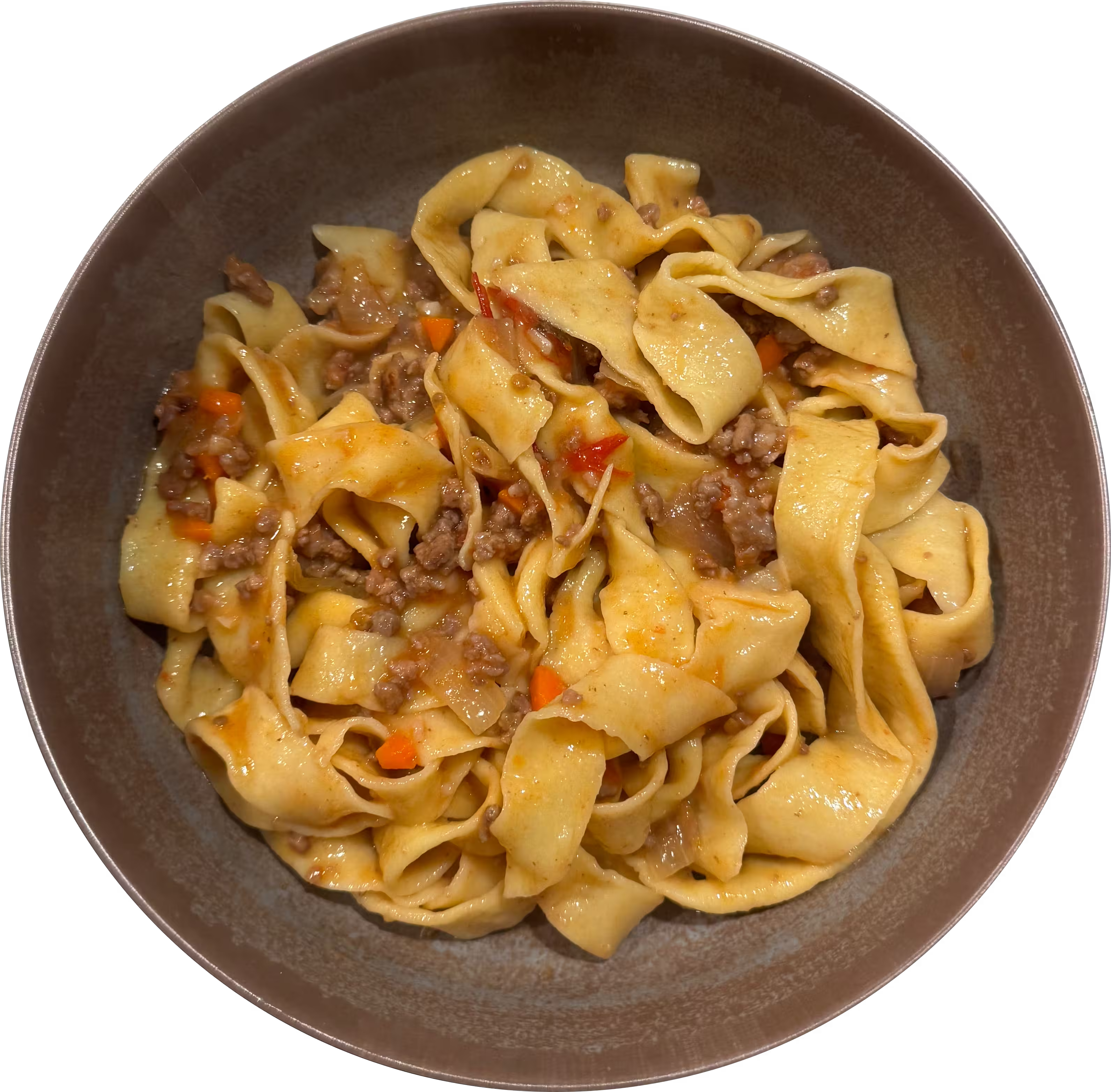
Pasta with Bolognese ragu has always been a staple in my kitchen, but taking the final step of making my own pasta always seemed too daunting. On a recent trip to Bologna, I overcame my pasta-making fears and learned how to make tagliatelle pasta by hand. With a little guidance and enough patience, it's actually not that hard to make. Combine one egg for every 100 grams of pasta flour. Knead until the dough is combined and springy before resting for 30 minutes. Then, carefully roll out the dough until it is as thin as possible and cut into half-inch strips before cooking.